
Managing a rental property sounds simple until you have to deal with tenant enquiries, property visits, rent collection, maintenance requests, lease renewals, inspections, documentation and unexpected emergencies.
For landlords who live in another city or country, these responsibilities can become even more challenging.
That is where a professional property management company can help. A good property manager does more than find a tenant and collect rent. They act as the operational link between the property owner, tenant, society, vendors and other stakeholders.
However, choosing the right company requires more than comparing management fees.
The wrong property management partner can lead to delayed rent, poor tenant screening, unnecessary maintenance expenses, weak communication and avoidable disputes. The right one can help protect your property, improve the tenant experience and make rental ownership significantly easier.
So, what should you look for when hiring a property management company?
Here are 12 important factors to evaluate before signing a property management agreement.
What Does a Property Management Company Actually Do?
Before comparing companies, it is important to understand what property management includes.
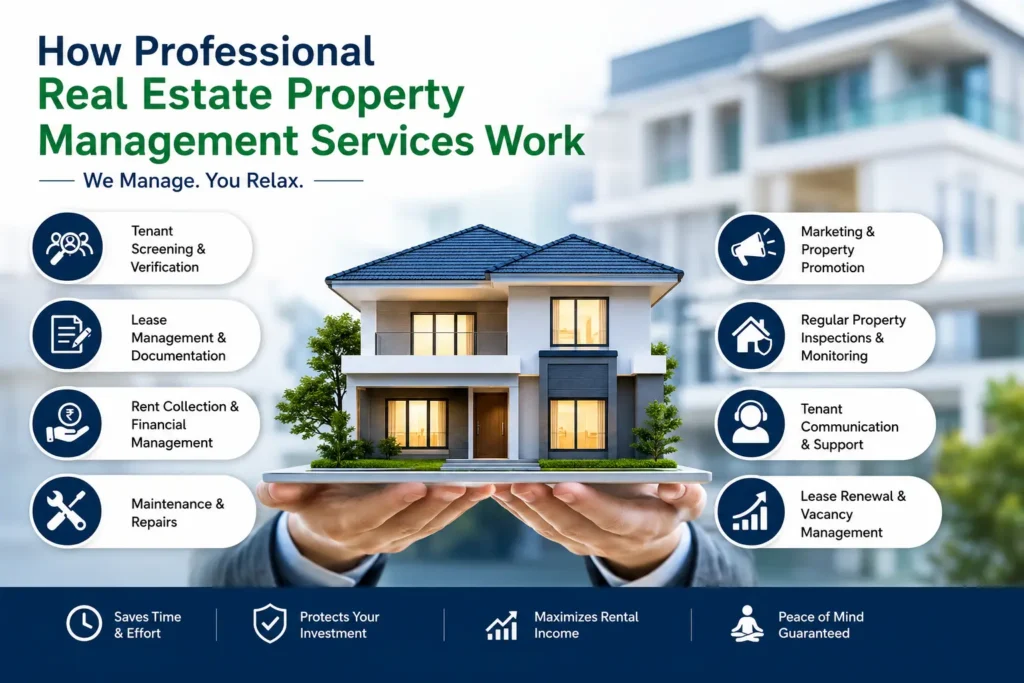
Depending on the provider and the service package, property management may cover:
- Finding and screening tenants
- Property visits and tenant coordination
- Rent collection and payment tracking
- Rental agreement coordination
- Move-in and move-out inspections
- Security deposit management
- Maintenance and repair coordination
- Utility and society coordination
- Periodic property inspections
- Lease renewals
- Tenant complaints and issue resolution
- Documentation and reporting
- Assistance during tenant exits
- Coordination with local vendors
- Support for owners living outside the city or India
Not every company provides all of these services, so the first question you should ask is:
“Exactly what is included in your property management service?”
Do not assume that two companies offering “full-service property management” provide the same scope of work.
12 Things to Look for When Hiring a Property Management Company
1. Look for Relevant Property Management Experience
Experience is one of the first things to evaluate, but don’t look only at the number of years a company has existed.
Look for relevant experience with properties similar to yours.
For example, managing:
- An independent house
- An apartment in a gated society
- Multiple residential units
- A luxury property
- A commercial property
can involve very different processes and operational challenges.
Ask the company:
- How many properties do you currently manage?
- What types of properties do you manage?
- Which locations do you cover?
- How long have you been managing rental properties?
- How many owners are based outside the city?
- How do you handle tenant disputes?
- What happens when a property remains vacant?
A company with experience in your property type and location is generally better positioned to understand local rental demand, tenant expectations and operational challenges.
2. Check the Company’s Reputation and Track Record
A company’s website can tell you what it promises. Its customers can tell you what it actually delivers.
Before hiring a property management company, look beyond testimonials displayed on its own website.
Check:
- Google reviews
- Independent reviews
- Customer testimonials
- Online reputation
- Complaints and recurring negative feedback
- References from existing or former clients
If possible, ask the company for references from property owners with a similar profile to yours.
Instead of asking only, “Are you happy with the company?”, ask more specific questions:
- Does the company respond quickly?
- Are maintenance costs communicated clearly?
- Is rent collected on time?
- How are tenant complaints handled?
- Are you given regular property updates?
- Are there unexpected charges?
- How easy is it to terminate the contract?
A few negative reviews do not necessarily mean a company is unreliable. Look for patterns rather than isolated complaints.
3. Understand Exactly What Services Are Included
One of the biggest mistakes landlords make is comparing property management companies purely on their monthly fee.
A cheaper company is not necessarily cheaper overall if important services are excluded.
Ask for a detailed service list covering:
(a) Tenant management
- Tenant sourcing
- Property visits
- Tenant screening
- Reference verification
- Rental agreement coordination
- Move-in support
- Tenant communication
(b) Rent management
- Rent collection
- Payment reminders
- Late-payment follow-up
- Rent reconciliation
- Owner payouts
- Monthly statements
(c) Property maintenance
- Repair coordination
- Vendor management
- Emergency maintenance
- Preventive maintenance
- Inspection visits
- Approval process for expenses
(d) Tenant exit
- Notice-period coordination
- Property inspection
- Damage assessment
- Final utility reconciliation
- Security deposit settlement
- Key handover
- Re-leasing
The more clearly these responsibilities are defined, the fewer misunderstandings you are likely to have later.
4. Compare the Fee Structure: Not Just the Management Fee
Property management pricing can vary depending on the property, location and services included.
A company may charge:
- A monthly management fee
- A percentage of monthly rent
- A tenant placement or leasing fee
- Renewal charges
- Inspection fees
- Maintenance coordination fees
- Marketing or vacancy-related charges
- Additional administrative charges
Before signing, request a complete fee schedule in writing.
Ask:
“If I pay your quoted management fee, what additional charges could I potentially incur?”
This question can reveal costs that may not appear in the headline pricing.
Also ask whether the fee is calculated on:
- Rent actually collected
- Rent due
- Gross rent
- A fixed monthly amount
Understanding the pricing model allows you to compare companies on a like-for-like basis.
5. Examine the Property Management Agreement Carefully
A property management agreement is more important than many landlords realise.
Do not sign based only on a sales conversation.
The agreement should clearly explain:
- Services included
- Fees and payment terms
- Responsibilities of the owner
- Responsibilities of the property manager
- Maintenance approval limits
- Tenant management responsibilities
- Rent collection process
- Reporting frequency
- Contract duration
- Renewal terms
- Notice period
- Termination conditions
- Liability and indemnity provisions
- Handling of owner funds
- Dispute resolution process
You should also understand what happens if you want to stop using the company’s services.
A good property management agreement should leave little room for ambiguity. If a company refuses to provide its agreement for review before you sign, consider that a warning sign.
6. Evaluate Tenant Screening and Verification
A property manager’s job does not end when a tenant is found.
Choosing the wrong tenant can create significant problems for a landlord, including delayed rent, property damage, disputes and a difficult exit.
Ask the company how it evaluates prospective tenants.
Depending on the circumstances and applicable law, the process may include:
- Identity verification
- Address verification
- Employment or income checks
- Reference checks
- Previous rental history
- Documentation checks
- Police or tenant verification where applicable
The exact requirements can vary by location and circumstances, so a professional manager should have a documented process rather than relying solely on informal references.
You should also ask:
“Who makes the final decision to approve a tenant the property manager or the owner?”
Ideally, the owner should have clear visibility into the proposed tenant before the tenancy is finalised.
7. Ask How Rent Collection and Delayed Payments Are Handled
Rent collection is one of the most important responsibilities of a property manager.
Do not simply ask:
“Do you collect rent?”
Ask what happens when rent is late.
A professional process should define:
- When rent becomes due
- When reminders are sent
- How late payments are followed up
- When the owner is notified
- What escalation steps are available
- How payment records are maintained
You should also receive a clear record of rent collected and any deductions.
Where applicable, landlords should understand their tax and documentation responsibilities as well. India’s tax framework includes provisions concerning TDS on rent, and the Income Tax Department introduced Form 141 under the Income Tax Act, 2025 for specified TDS transactions including rent paid by an individual/HUF. [1]
Important: Tax obligations can depend on the landlord’s status, tenant profile, rent amount and other circumstances. Property owners should obtain professional tax advice for their specific situation.
8. Check How Maintenance and Repairs Are Managed
Maintenance is one area where a property manager can either save you time or become a source of frustration.
Ask:
- How are maintenance requests received?
- How quickly are urgent issues addressed?
- Does the company have its own maintenance team?
- Does it use external vendors?
- How are vendors selected?
- How are repair quotations obtained?
- At what cost does owner approval become mandatory?
- Will you receive invoices and photographs?
- How are emergency repairs handled?
For example, you may agree that the property manager can authorise small repairs up to a predetermined amount without asking for approval every time. For larger expenses, the owner may want a quotation and approval before work begins.
These limits should be clearly documented in the agreement.
9. Look for a Proper Property Inspection and Handover Process
A good property manager should have a documented process for both move-in and move-out.
This is particularly important for furnished or high-value properties.
A proper inspection can record:
- Walls and paint
- Flooring
- Doors and windows
- Electrical fittings
- Plumbing fixtures
- Appliances
- Furniture
- Fixtures and fittings
- Meter readings
- Existing damage
- Keys/access cards
- Other inventory items
Photographs and inspection records can provide useful evidence when resolving disputes about property condition.
Ask the property management company:
“Do you prepare a move-in and move-out inspection report?”
If the answer is unclear, ask how property condition and tenant-caused damage are documented.
10. Evaluate Technology and Owner Reporting
Technology should not be treated as a marketing gimmick.
The real question is:
Does the technology make property ownership easier for you?
A useful property management platform can provide access to information such as:
- Rent payment status
- Property expenses
- Maintenance requests
- Tenant information
- Agreements and documents
- Inspection reports
- Owner statements
- Communication history
For remote owners and NRIs, digital access can be particularly valuable because they may not be physically available to inspect the property or meet the tenant.
A good owner dashboard should help you answer basic questions without having to repeatedly call the property manager.
11. Check Communication Standards and Emergency Response
Many property management problems are actually communication problems.
Before hiring a company, find out:
- Who will be your point of contact?
- Is there a dedicated relationship manager?
- How can you contact the company?
- What are the response timelines?
- Is support available outside business hours?
- How are emergencies escalated?
- How often will you receive property updates?
For example, a leaking pipe at 11 PM is very different from a request to replace a light bulb. A good property manager should have different response and escalation procedures for routine maintenance and emergencies.
Ask the company to explain its process for situations such as:
- Water leakage
- Electrical failure
- Lockouts
- Major appliance failure
- Security concerns
- Tenant complaints
- Society notices
- Unexpected property damage
12. Understand Legal, Documentation and Local Compliance Responsibilities
Property management involves more than finding tenants and collecting rent.
Depending on the location and circumstances, landlords may have obligations involving:
- Tenancy agreements
- Stamp duty and registration
- Tenant verification
- Local municipal requirements
- Society rules
- Tax documentation
- TDS
- Security deposits
- Notices and renewals
- Maintenance responsibilities
Rental and tenancy rules can also vary between states and jurisdictions.
For example, tenancy legislation in India can address matters such as tenancy agreements, security deposits, rent payments, repairs, maintenance, entry to premises and the duties of property managers. The exact law applicable to a property depends on the relevant jurisdiction and circumstances.
Therefore, don’t simply ask a property management company whether it is “legal compliant.”
Ask:
“Which documentation and compliance activities do you handle, and which remain my responsibility as the property owner?”
That distinction is important.
What Should an NRI Look for in a Property Management Company?
For NRIs, property management can be significantly more complicated because the owner may be thousands of kilometres away.
An NRI property management service should ideally help with:
- Tenant search
- Tenant screening
- Property visits
- Rental agreement coordination
- Rent collection
- Maintenance
- Tenant communication
- Property inspections
- Lease renewals
- Tenant exits
- Documentation
- Regular reporting
Financial administration is another consideration. The Reserve Bank of India states that current income such as rent can be remitted from an NRO account subject to applicable conditions and taxes; specific banking and tax requirements can apply.
This is why an NRI owner should ask a property manager:
“How do you handle rent collection, documentation, statements and coordination with my bank/CA?”
A property manager should not replace your Chartered Accountant or tax adviser, but they can make the operational side of owning property remotely much easier.
Red Flags to Watch for When Hiring a Property Manager
Before signing a contract, watch for these warning signs.
1. Extremely low fees with unclear inclusions
A very low management fee may look attractive, but check what services are excluded.
2. No written agreement
Never rely solely on verbal promises.
3. No clear maintenance approval process
You should know who can authorise expenses and up to what amount.
4. No tenant screening process
If a company cannot explain how tenants are evaluated, ask why.
5. Poor communication during the sales process
If getting a response before becoming a customer is difficult, the experience may not improve after signing.
6. No transparent reporting
You should be able to understand rent received, expenses and deductions.
7. No clear termination clause
Understand how you can end the relationship if the service does not meet expectations.
8. One person handles everything without operational backup
A dedicated individual can be helpful, but there should also be a system for handling emergencies, leave and high workloads.
9. Pressure to sign immediately
A professional company should allow you to review the agreement and ask questions before committing.
Questions to Ask a Property Management Company Before Hiring
Before making your final decision, ask these questions:
- How many properties do you currently manage?
- How long have you been providing property management services?
- Do you manage properties similar to mine?
- What locations do you cover?
- What exactly is included in your management fee?
- What additional charges can I expect?
- How do you screen tenants?
- How do you handle delayed rent?
- How do you manage maintenance?
- What is the approval limit for repairs?
- Do you conduct move-in and move-out inspections?
- How frequently will I receive reports?
- Do I get access to an owner dashboard?
- Who will be my primary contact?
- How are emergencies handled?
- How do you handle tenant disputes?
- What happens when the tenant wants to renew?
- What happens when the tenant wants to vacate?
- What is the notice period for terminating your service?
- Can I review the property management agreement before signing?
If a company can answer these questions clearly, you will have a much better understanding of what you are actually buying.
Is Hiring a Property Management Company Worth It?
For some landlords, managing one property independently may be straightforward.
But as the number of properties increases or when the owner lives in another city or country, the administrative workload can become significant. Consider the value of your own time.
If you are personally handling:
- Tenant calls
- Property visits
- Rent reminders
- Maintenance requests
- Vendor coordination
- Society communication
- Lease renewals
- Tenant exits
- Inspections
You are effectively managing a small business operation around your property.
A professional property management company can take responsibility for many of these recurring tasks and provide a structured process for managing the property. The objective isn’t simply to “avoid work.” It is to have a reliable system for protecting the property, managing the tenancy and keeping the owner informed.
Final Checklist Before You Hire a Property Management Company
Before signing the agreement, make sure you have answers to all of these:
- What services are included?
- What services cost extra?
- How much is the management fee?
- How is the fee calculated?
- How are tenants screened?
- How is rent collected?
- What happens if rent is delayed?
- How are maintenance requests handled?
- What is the emergency response process?
- What repair amount requires owner approval?
- Are move-in/move-out inspections conducted?
- How are property expenses documented?
- How frequently are reports provided?
- Is an owner dashboard available?
- Who is the point of contact?
- What are the contract and termination terms?
- How are tenant disputes handled?
- How are lease renewals managed?
- How is the security deposit handled?
- What happens when the property becomes vacant?
- Which legal/tax/compliance responsibilities are handled by the company?
- What support is available for NRI or remote owners?
If you cannot get clear answers to these questions, take a step back before signing.
Why SecuredHomes Can Help
Managing a rental property should not require you to constantly coordinate between tenants, vendors, societies and service providers. SecuredHomes provides professional property management support designed to simplify rental property ownership.
From tenant management and rent collection to maintenance coordination and ongoing property support, the goal is to give property owners greater visibility and peace of mind. For owners who live outside the city or outside India having a reliable team on the ground can make managing an Indian rental property considerably easier.
If you are looking for professional property management services, speak with SecuredHomes to understand how your property can be managed more efficiently.
Frequently Asked Questions About Hiring a Property Management Company
1. What is a property management company?
A property management company manages the day-to-day operational responsibilities associated with a rental property on behalf of the owner. Depending on the service package, this can include tenant management, rent collection, maintenance, inspections, documentation, lease renewals and property reporting.
2. How much does a property management company charge?
Property management fees vary by company, property type, location and services provided. Some companies charge a percentage of rent, while others may use fixed fees or separate charges for leasing, renewals and maintenance-related services.
Always compare the total fee structure and included services, rather than looking only at the headline management fee.
3. Is it worth hiring a property manager for one property?
It can be, particularly if you live in another city, travel frequently or do not have the time to handle tenants and maintenance yourself.
The decision ultimately depends on the rental income, property value, distance from the property and the amount of time you want to spend managing it.
4. What should a property manager do for a landlord?
A property manager may handle tenant sourcing, screening, rent collection, maintenance coordination, inspections, lease renewals, tenant communication and reporting.
The exact responsibilities should always be defined in the property management agreement.
5. How does a property management company find tenants?
Property managers may advertise the property through online channels, respond to tenant enquiries, arrange property visits, evaluate prospective tenants and coordinate the rental documentation.
Ask the company what channels it uses and how it screens applicants.
6. Does a property management company guarantee rent?
Not necessarily. A property manager can have systems for rent collection and follow-up, but landlords should not assume that management automatically means guaranteed rental income.
If a company offers a rent guarantee or similar arrangement, carefully review the eligibility conditions and contract terms.
7. Who pays for property maintenance?
The property owner generally bears the cost of owner-responsible repairs and maintenance, subject to the tenancy agreement and applicable law. Tenant-caused damage may be treated differently depending on the circumstances.
The property management agreement should explain who approves repairs and how expenses are handled.
8. Can an NRI hire a property management company in India?
Yes. Property management companies can help NRIs manage rental properties remotely by handling tasks such as tenant coordination, rent collection, maintenance, inspections and reporting.
NRIs should also understand the applicable tax, banking and foreign-exchange requirements for their individual circumstances. [3]
9. Should I choose the property management company with the lowest fee?
Not necessarily.
The lowest fee may not represent the lowest overall cost if important services are excluded or communication and maintenance processes are weak.
Compare service scope, transparency, reporting, tenant management, maintenance and contract terms before comparing price.
10. What should be included in a property management agreement?
A property management agreement should clearly define services, fees, owner and manager responsibilities, maintenance approval limits, reporting, tenant management, contract duration, termination, liability and other relevant terms.
11. How can I tell whether a property management company is trustworthy?
Look for a combination of experience, independent reviews, transparent pricing, documented processes, clear contracts, responsive communication and references from existing customers.
Do not rely on testimonials alone.
12. Can a property management company handle tenant complaints?
Yes. Tenant communication and complaint handling are common property management responsibilities, although the exact scope varies between companies.
Before hiring one, ask how complaints are received, recorded, escalated and resolved.
13. How often should a property manager inspect my property?
There is no universal frequency that is appropriate for every property. It can depend on the property type, tenancy, owner requirements and applicable rules.
More important than a fixed number is having a clearly defined inspection process and receiving appropriate reports from the property manager.
14. What happens when a tenant moves out?
A professional property management process should cover the notice period, property inspection, outstanding rent or utility payments, damage assessment, security deposit reconciliation, key handover and preparation of the property for the next tenant.
Conclusion
Choosing a property management company is not simply about finding someone who can collect rent. You are entrusting another organisation with an asset that may represent a significant part of your wealth.
The right property manager should combine experience, transparent pricing, tenant screening, reliable maintenance, clear communication, technology, documentation and well-defined processes.
Before you hire, ask questions, compare service agreements and understand exactly what the company will and will not do for you.
For remote owners and NRIs, the right property management partner can turn property ownership from a constant administrative responsibility into a much more manageable investment.