
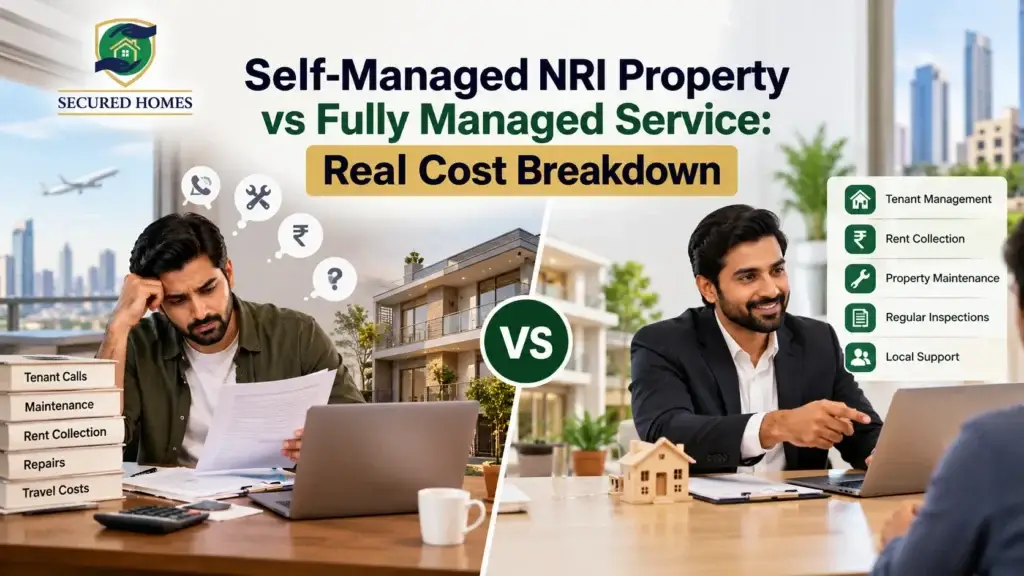
Owning property in India can be a valuable investment for NRIs. However, managing that property from another country can become difficult, especially when there are tenants, maintenance issues, rent collection, paperwork, and regular property inspections involved.
For many NRIs, the main question is simple: Should you manage your property yourself or hire a fully managed property management service?
At first glance, self-management may seem cheaper because there is no professional management fee. But the actual cost can include much more than a monthly service charge. This guide compares self-managed NRI property vs fully managed service, including the direct and hidden costs that property owners should consider before making a decision.
What Does Self-Managing an NRI Property Mean?
Self-managing means the property owner handles most property-related responsibilities without hiring a professional property management company.
For an NRI, this could include:
- Finding and screening tenants
- Responding to tenant calls
- Collecting rent
- Handling maintenance requests
- Coordinating plumbers, electricians, and other workers
- Inspecting the property
- Managing lease agreements
- Handling tenant move-in and move-out
- Following up on unpaid rent
- Checking utility bills
- Managing repairs and renovations
If you live outside India, you may need to depend on family members, friends, neighbours, brokers, or local service providers to complete these tasks.
This may reduce professional service fees, but it does not necessarily make property management free.
What Is a Fully Managed Property Management Service?
A fully managed service means a professional property management company handles the day-to-day responsibilities of your property on your behalf.
Depending on the company and service package, this can include:
- Tenant search and screening
- Property marketing
- Rent collection
- Lease coordination
- Property inspections
- Maintenance management
- Tenant communication
- Move-in and move-out assistance
- Rent follow-ups
- Vendor coordination
- Regular property updates
For NRIs, this can be particularly useful because the property can be managed locally while the owner continues living abroad.
Self-Managed NRI Property vs Fully Managed Service: Cost Comparison
The easiest way to understand the difference is to look beyond the management fee.
| Cost Factor | Self-Managed Property | Fully Managed Service |
|---|---|---|
| Tenant search | Owner/family handles it | Usually handled by company |
| Rent collection | Owner/family handles it | Usually managed by company |
| Maintenance coordination | Owner/family handles it | Managed by property manager |
| Property inspections | Owner or local contact | May be included |
| Tenant communication | Owner/local contact | Property manager handles it |
| Emergency issues | Owner must coordinate | Local team can coordinate |
| Travel expenses | Possible | Usually reduced |
| Time commitment | High | Lower |
| Management fee | No professional fee | Usually applicable |
| Vendor coordination | Owner/local contact | Usually handled by company |
| Remote convenience | Limited | Higher |
The exact costs vary depending on the property, location, service provider, and agreement.
1. Tenant Search Can Have a Hidden Cost
Finding a suitable tenant may look simple, but it can take considerable time.
A self-managing NRI may need to:
- Create property listings
- Respond to enquiries
- Schedule property visits
- Coordinate with brokers
- Verify tenant information
- Negotiate rent
- Prepare or review the rental agreement
If you are abroad, someone locally may have to handle property visits and meetings.
A professional property management service can take care of much of this process. The important point is that your time and the time of your local representative also have a value, even if you are not paying a separate management fee.
2. Rent Collection and Follow-Ups
Rent collection is another regular responsibility.
With self-management, you may need to monitor whether rent has been received on time and contact the tenant if payment is delayed. For an NRI living in another time zone, even a simple rent-related issue can require additional communication.
A fully managed service may handle rent collection and follow-ups according to the agreed service package. This can make the process more convenient for owners who do not want to manage monthly tenant communication.
3. Property Maintenance Costs
Maintenance is one of the biggest responsibilities of owning a rental property.
Common issues include:
- Plumbing problems
- Electrical repairs
- Appliance problems
- Water leakage
- Painting
- Air-conditioning maintenance
- Furniture repairs
- Lock and key issues
- General cleaning
The actual repair cost is generally separate from the property management fee. Whether you manage the property yourself or use a professional service, the repair itself still needs to be paid for.
The difference is who coordinates the repair.
With self-management, you may need to find a technician, compare prices, schedule the work, and follow up.
With a fully managed service, the property manager may coordinate with local vendors on your behalf.
4. The Cost of Property Inspections
Regular inspections can help identify problems before they become expensive repairs.
For example, a small water leak could become a major issue if it is not noticed early.
If you are managing the property yourself from another country, you may need to ask a family member, friend, broker, or local representative to visit the property.
There may not always be a direct invoice for this work, but there can be indirect costs such as:
- Travel expenses
- Transportation
- Time spent visiting the property
- Coordination with tenants
- Follow-up visits
A professional service may offer property inspections as part of its management package or as an additional service.
5. Emergency Maintenance Can Be More Expensive Than Expected
Imagine your tenant contacts you at night because of a water leakage or electrical problem.
If you are living abroad, you cannot simply visit the property.
You may have to:
- Contact someone locally.
- Find a suitable technician.
- Coordinate access to the property.
- Approve the repair.
- Check whether the work was completed.
- Follow up with the tenant.
The repair itself may be affordable, but managing the entire situation remotely can take significant time and effort.
A local property manager can often coordinate these steps for you.
6. Vacancy Can Affect the Real Cost
One of the most important costs for rental property owners is vacancy. If a property remains empty for one or two months between tenants, the owner may lose rental income.
For example, suppose your property normally generates ₹25,000 per month in rent. If it remains vacant for two months:
₹25,000 × 2 = ₹50,000 in lost rental income.
This is not necessarily a cost caused by self-management. However, finding a new tenant efficiently can help reduce the length of a vacancy. Professional property management services may assist with marketing, tenant enquiries, property visits, and onboarding, depending on the package.
7. Travel Costs for NRIs
This is one of the costs that is easy to overlook.
If you travel to India specifically to deal with property-related matters, your overall cost may include:
- Flights
- Local transportation
- Accommodation
- Food
- Time away from work
- Other travel expenses
Of course, most NRIs do not travel to India only for property management. But when property issues influence travel plans, the financial impact can become significant.
A local property management service can reduce the need for the owner to be physically present for routine matters.
8. Your Time Also Has a Cost
This is perhaps the biggest hidden cost of self-management.
Suppose you spend:
- 2 hours finding a tenant
- 1 hour handling maintenance calls
- 1 hour checking rent
- 2 hours coordinating repairs
- 2 hours handling tenant communication
That is 8 hours of your time.
For an NRI working a full-time job or running a business abroad, those hours may be more valuable than they initially appear. A professional property manager charges a fee, but in return, the owner transfers many routine responsibilities to a local team.
9. What Does Fully Managed NRI Property Management Cost?
There is no single fixed price for NRI property management services.
The cost can depend on:
- Property location
- Property type
- Number of properties
- Monthly rent
- Services included
- Tenant-related services
- Maintenance requirements
- Inspection frequency
- Leasing services
- Additional administrative services
Some companies charge a percentage of the rent, while others may use fixed fees or different charges for individual services.
Therefore, NRIs should compare the complete service package, rather than looking only at the headline management fee.
10. Look Beyond the Management Fee
A common mistake is to compare:
Self-management = ₹0 management fee
against
Professional management = monthly management fee
This comparison is incomplete.
A better calculation considers:
Total Self-Management Cost =
Tenant management + maintenance coordination + travel + local assistance + communication time + vacancy-related costs + administrative work.
For professional management:
Total Managed Cost =
Management fee + actual property expenses + any additional service charges. The actual numbers will vary from property to property.
Example: A Simple Cost Breakdown
Let’s consider a hypothetical Bangalore rental property generating ₹30,000 per month.
Self-managed option
The owner may not pay a monthly management fee, but could still have:
- Local travel or representative expenses
- Tenant communication
- Maintenance coordination
- Occasional property visits
- Brokerage or tenant-finding costs
- Time spent managing the property
- Potential vacancy-related losses
Fully managed option
The owner may pay a management fee based on the agreed service structure.
In exchange, the property manager may handle:
- Tenant communication
- Rent collection
- Maintenance coordination
- Property inspections
- Tenant onboarding
- Move-in and move-out coordination
The key is not simply to ask, “Which option has the lower fee?”
Instead, ask:
“Which option gives me the better balance between cost, time, control, convenience, and property care?”
When Does Self-Management Make Sense?
Self-management may work well when:
- You have a trusted family member nearby.
- You live close enough to visit the property regularly.
- You have only one property.
- You have reliable local vendors.
- Your tenant is stable and easy to communicate with.
- You are comfortable handling maintenance and paperwork.
- You want maximum direct control.
In these situations, avoiding a professional management fee may make sense.
When Should an NRI Consider Fully Managed Services?
Professional NRI property management in Bangalore may be worth considering when:
- You live outside India.
- You have multiple properties.
- You do not have trusted local support.
- You have limited time.
- You do not want to deal with tenant issues.
- You frequently travel for work.
- Maintenance problems are difficult to manage remotely.
- You want regular property monitoring.
- You want one local point of contact.
The decision depends on your property, location, rental income, and how much involvement you want.
Questions to Ask Before Hiring a Property Management Company
Before choosing a property management company, ask:
1. What is included in the management fee?
Ask for a clear list of included services.
2. Are there additional charges?
Check whether tenant placement, inspections, maintenance coordination, or other services have separate fees.
3. How are maintenance vendors selected?
Ask whether vendors are verified and how repair costs are approved.
4. How frequently will my property be inspected?
Understand whether inspections are included and how inspection reports are shared.
5. How is rent collected?
Ask about the payment process and what happens when rent is delayed.
6. How are tenant complaints handled?
Make sure you understand who will communicate with tenants.
7. What happens when the property becomes vacant?
Ask whether the company helps market the property and find a new tenant.
Final Thoughts
For NRIs, the real cost of property ownership is not limited to rent, repairs, or a property management fee.
Self-managed NRI property can reduce professional management expenses, but it requires time, local coordination, and regular involvement.A fully managed service adds a professional fee but can transfer many day-to-day responsibilities to a local team.
The right approach depends on your circumstances. Before making a decision, compare the complete cost of both options, including time, travel, maintenance coordination, tenant management, vacancy, and convenience. For NRIs managing property from abroad, understanding these costs can help create a more practical and transparent property management strategy.
